
The Rise of Spatial Commerce
Preparing Retail for AI Shopping Agents
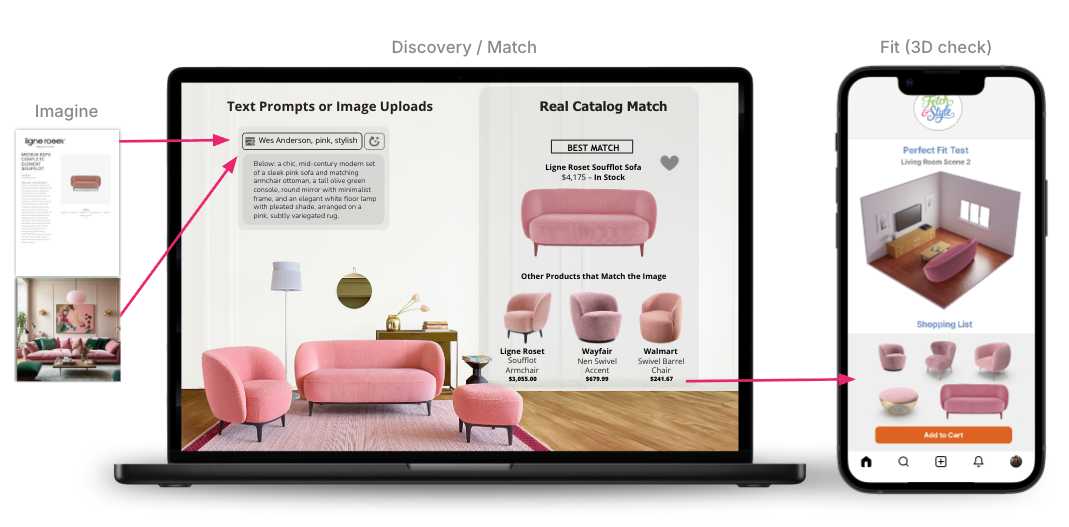
For decades, eCommerce has been built around screens, search bars, and product grids. But a new paradigm is emerging—one where AI agents, spatial computing, and immersive product data reshape how consumers discover and buy products.
Welcome to the era of spatial commerce.
Spatial commerce blends the physical and digital shopping worlds by allowing consumers—or increasingly their AI assistants—to interact with products in three-dimensional environments rather than flat web pages. Using technologies such as 3D modeling, augmented reality, and spatial computing, shoppers can visualize products directly within their own spaces before purchasing. (Fetch&Style)
But the bigger shift isn’t just immersive visualization.
It’s AI-driven shopping agents.
The Shift From Search to Agents
Traditional online shopping requires customers to:
Search for products
Compare options
Read reviews
Make a purchase decision
AI shopping agents collapse this entire process.
Instead of manually browsing catalogs, autonomous AI systems can discover products, evaluate options, and complete purchases on behalf of users based on their preferences and constraints. (Wikipedia)
Consultancies like McKinsey describe this shift as “agentic commerce,” where intelligent agents proactively handle the entire shopping journey—from discovery to checkout. (McKinsey & Company)
In other words:
Consumers won’t search for products.
Their AI will.
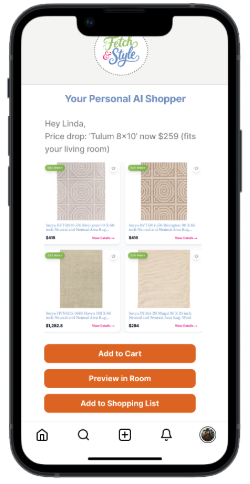
Always on shopping agent
Why Spatial Data Becomes Critical
If AI agents are doing the shopping, retailers must rethink how products are represented online.
Traditional catalogs were designed for humans browsing web pages.
AI agents require something different:
Machine-readable product data
Structured metadata
Contextual information
Spatial compatibility
For categories like home décor, furniture, appliances, and fashion, spatial compatibility becomes essential.
An AI agent doesn’t just need to know:
What the product is
How much it costs
It needs to know:
Will this couch fit in a 12×14 living room?
Does the style match modern Scandinavian interiors?
Does it work with the user’s existing furniture?
This is where spatial commerce platforms begin to reshape retail infrastructure.
From Product Catalogs to Spatial Catalogs
Retailers today manage large product catalogs, but these catalogs are rarely optimized for spatial interactions.
A spatial catalog includes:
3D product models
dimensional data
style attributes
room compatibility
environmental context
Instead of browsing a page of sofas, a shopper—or their AI agent—can generate an entire room design and select products that fit within it.
The catalog becomes a design engine rather than a product database.
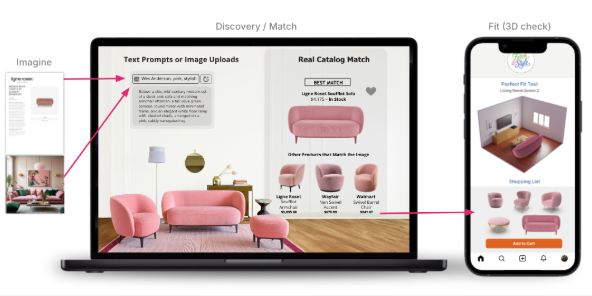
The Future of Retail Interfaces
The next generation of commerce interfaces will likely combine:
conversational AI
spatial visualization
autonomous purchasing agents
Imagine telling your AI assistant:
“Design a cozy modern living room under $5,000.”
The agent could:
Analyze your room dimensions
Generate several design options
select compatible products
verify availability and pricing
complete the purchase
All without traditional browsing.
Why Retailers Must Act Now
This transition will happen faster than many brands expect.
AI agents are already changing how consumers discover information online. Nearly half of users who try AI search tools say they prefer them over traditional search engines. (McKinsey & Company)
Commerce will follow the same trajectory.
Retailers who prepare their product data for AI discovery and spatial interaction will gain a major advantage in the next wave of digital commerce.
Those who don’t risk becoming invisible to the agents making purchasing decisions.
The next evolution of commerce won’t be built on webpages.
It will be built on spaces, data, and intelligent agents.
See how your catalog scores.
Run Your Free Audit: AI Commerce Readiness Score
Book a Strategy Call: Fetch & Style
