

Why Structured Product Data Is Becoming a Competitive Moat

Product Data Is the New Distribution Channel
Shopify’s move to make every product in its ecosystem purchasable directly inside AI assistants signals a structural shift in commerce.
Product catalogs are no longer just ecommerce infrastructure.
They are distribution infrastructure.
The brands that win won’t just have better ads.
They’ll have better product data.
Structured attributes.
Dimensional intelligence.
Compatibility logic.
Semantic richness.
Because AI doesn’t browse.
AI reasons.
From Keywords to Context
In the web era, discovery was driven by keywords and ranking algorithms.
In the AI era, discovery is driven by contextual reasoning.
AI systems evaluate products based on:
whether they fit a space
whether they match a style
whether they complement existing items
whether they meet constraints like size, price, sustainability, or availability
The question is no longer:
“Is this product visible?”
The question is:
“Is this product relevant?”
Relevance converts.
Home Décor Is the Perfect AI Commerce Category
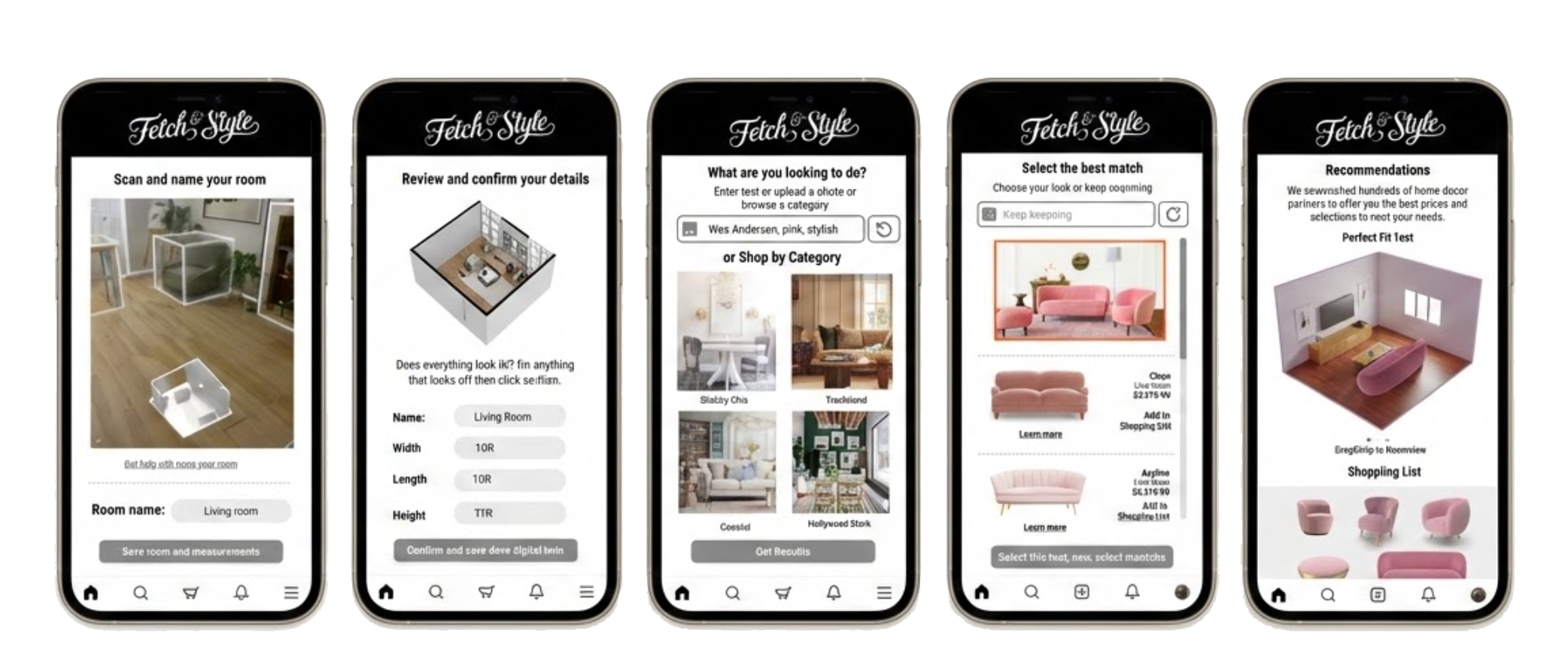
Fetch & Style Platform
At Fetch & Style, we’re seeing this shift accelerate in home décor — a category defined by complexity:
spatial constraints
aesthetic cohesion
dimensional accuracy
multi-item compatibility
high return costs
Consumers don’t ask:
“show me a sofa”
They ask:
“what sofa fits my living room and works with my style?”
That requires more than a catalog.
It requires spatial context.
The Rise of Spatial Commerce
Fetch & Style builds a digital twin of the home and maps products against:
real room geometry
style embeddings
dimensional fit logic
compatibility signals across multi-brand catalogs
evolving consumer preferences
Instead of filtering a flat catalog, consumers interact with an AI stylist agent that understands both the product and the space it must live in.
This transforms product discovery from search → into reasoning.
From browsing → into designing.
From guessing → into knowing.
Our platform combines LiDAR-based spatial capture, generative AI styling, and structured product data to create a persistent intelligence layer between consumer intent and brand inventory .
Why Product Intelligence Wins in an AI-First Economy
When AI assistants become a primary interface for commerce, the quality of product intelligence determines distribution advantage.
Winning product data includes:
structured dimensional attributes
normalized materials and finishes
style embeddings and visual vectors
compatibility relationships
pricing and availability signals
3D geometry and spatial metadata
In other words:
Products must become machine-understandable.
Because AI doesn’t interpret inspiration boards.
AI interprets structured meaning.
Visibility Is No Longer Enough
In an AI-native commerce environment, the winning products won’t just be visible.
They’ll be contextually relevant.
And contextual relevance requires:
richer product metadata
spatial awareness
compatibility logic
continuously learning recommendation systems
The shift is clear:
Distribution advantage is moving from media buying to data modeling.
From impressions to embeddings.
From clicks to context.
The Next Era of Commerce Infrastructure
Just as mobile reshaped UX and marketplaces reshaped distribution, AI is reshaping how products are discovered, evaluated, and purchased.
The next generation of commerce platforms will not simply host products.
They will understand them.
Fetch & Style is building the spatial intelligence layer that allows products to exist not just in catalogs — but inside real environments.
Because the future of commerce isn’t about showing more products.
It’s about showing the right product, in the right space, at the right moment.
Let us know what you think, email us at hello@fetchandstyle.com
