
AI Should Make Life Easier. Let’s Start at Home.
AI has a reputation problem. But beyond the headlines, AI in home design and remodeling has the potential to solve a very practical problem: helping people get from inspiration to a finished space with less searching, uncertainty, and frustration.
From discovering furniture across brands to visualizing products in your room and determining whether something will actually fit, AI can make the process of designing a home simpler—not by replacing human creativity, but by helping us make better decisions faster.
Depending on what you read, it’s coming for our jobs, replacing creativity, flooding the internet with synthetic content, or making decisions humans should be making for themselves.
Those are conversations worth having.
But they can also overshadow a much simpler question:
Can we use AI to make everyday life a little easier?
I think we can. And the home is a great place to start.
The problem isn't a lack of inspiration
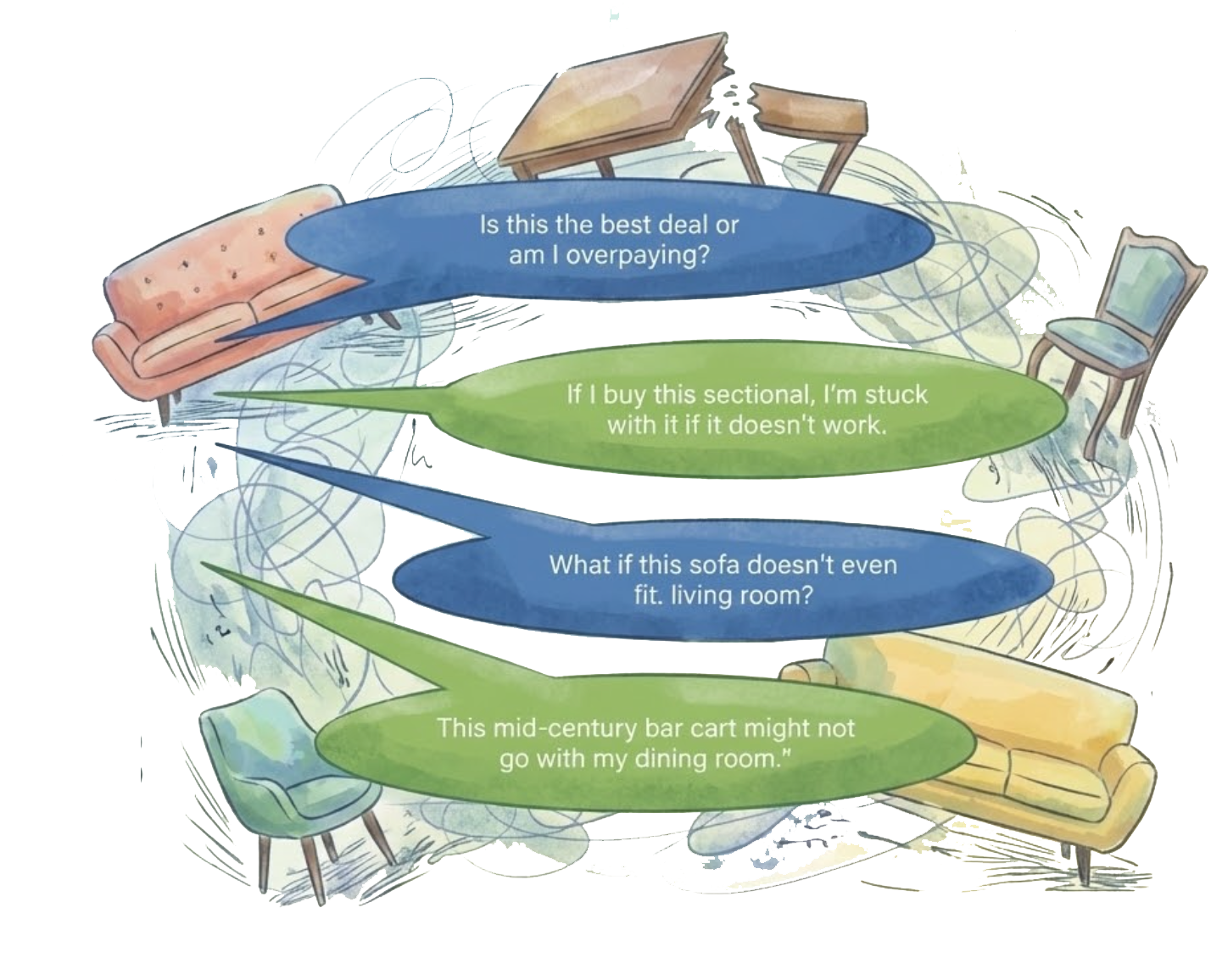
Anyone who has remodeled a room knows how quickly excitement can turn into overwhelm.
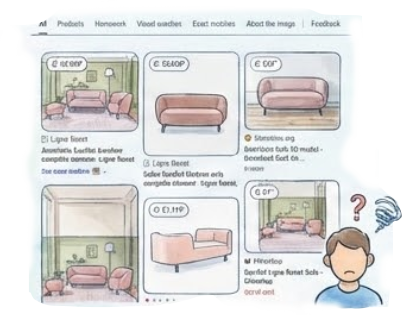
You save inspiration. Open 37 browser tabs. Visit six websites. Compare three sofas that somehow all describe the color beige differently. Measure the wall again. Wonder whether an 88-inch sofa is actually too large. Try to remember whether the rug you liked works with the coffee table you saved two weeks ago.
There are millions of beautiful products available to us.
Finding the right ones is the hard part.
And that's where I think AI becomes interesting.
AI doesn't have to replace your taste
I don't want AI deciding what my home should look like.
I want it to understand what I want my home to look like—and help me get there faster.
There's an important difference.
Imagine being able to say:
“I want this room to feel like an English country house, but less formal. I need a sofa under 84 inches, performance fabric because I have kids, and I'd like to stay under $3,000.”
Instead of translating that idea into dozens of searches across dozens of websites, technology should be able to understand the intent behind it.
It should help find relevant products.
It should help you see how they work together.
It should tell you whether they'll physically fit.
And ultimately, it should help you make a more confident decision.
You're still designing your home. AI is simply doing more of the legwork.
From search engine to shopping assistant
For years, digital shopping has largely asked humans to adapt to computers.
Pick a category.
Select a filter.
Choose a color from a predefined list.
Set a price range.
Scroll.
Scroll some more.
Open another website and start again.
But humans don't naturally think about their homes as database fields.
We think in ideas:
I want it warmer.
This room feels empty.
I love the apartment from that show.
I need more seating, but I don't want the room to feel crowded.
I want this bedroom to feel like a boutique hotel.
AI creates an opportunity for technology to start understanding our language, instead of requiring us to learn the language of a product catalog.
Getting from inspiration to reality
This is one of the ideas behind Fetch & Style.
We're exploring how AI, product intelligence, visualization, and spatial technology can work together to shorten the distance between “I know what I want” and “this works in my home.”
That might mean helping someone discover products across different brands.
It might mean understanding that “Mad Men living room” isn't a product category—it's an aesthetic.
It might mean taking a room's dimensions into account before recommending furniture.
Or helping someone visualize a product in their actual space before spending thousands of dollars and hoping it works.
None of those things removes the human from the process.
They give the human better information with which to make the decision.
Less searching. More creating.
That's the version of AI I'm interested in.
Not technology for technology's sake.
Not replacing the designer, homeowner, retailer, or brand.
Not telling people what they should like.
But reducing the tedious work between an idea and an outcome.
If you're remodeling your living room, the goal isn't to become exceptionally good at searching furniture catalogs.
The goal is to create a living room you love.
Technology should help you get there.
Maybe that's one of the better ways to think about the future of AI—not by asking how much more it can do for us, but how much unnecessary friction it can remove around us.
Because the best technology eventually stops feeling like technology.
It simply makes something that used to be hard feel easier.
And when it comes to creating a home you love, I think that's a future worth building.
