
From Product Data to Product Intelligence

Preparing for the next era of AI commerce
For decades, ecommerce has been built around a relatively simple model.
A retailer creates a product record. The record contains a title, description, price, dimensions, category, images, and a collection of attributes. Shoppers search or browse the catalog, apply filters, open product pages, and make decisions.
That model was built primarily for humans navigating websites.
AI shopping changes the equation.
Consumers are increasingly able to describe what they want conversationally:
"Find a sofa that will work in my small living room, coordinate with warm oak floors, seat four people, and stay under $2,500."
Answering that question requires much more than knowing that a product is a sofa.
AI needs to understand the product.
And that is the difference between product data and product intelligence.
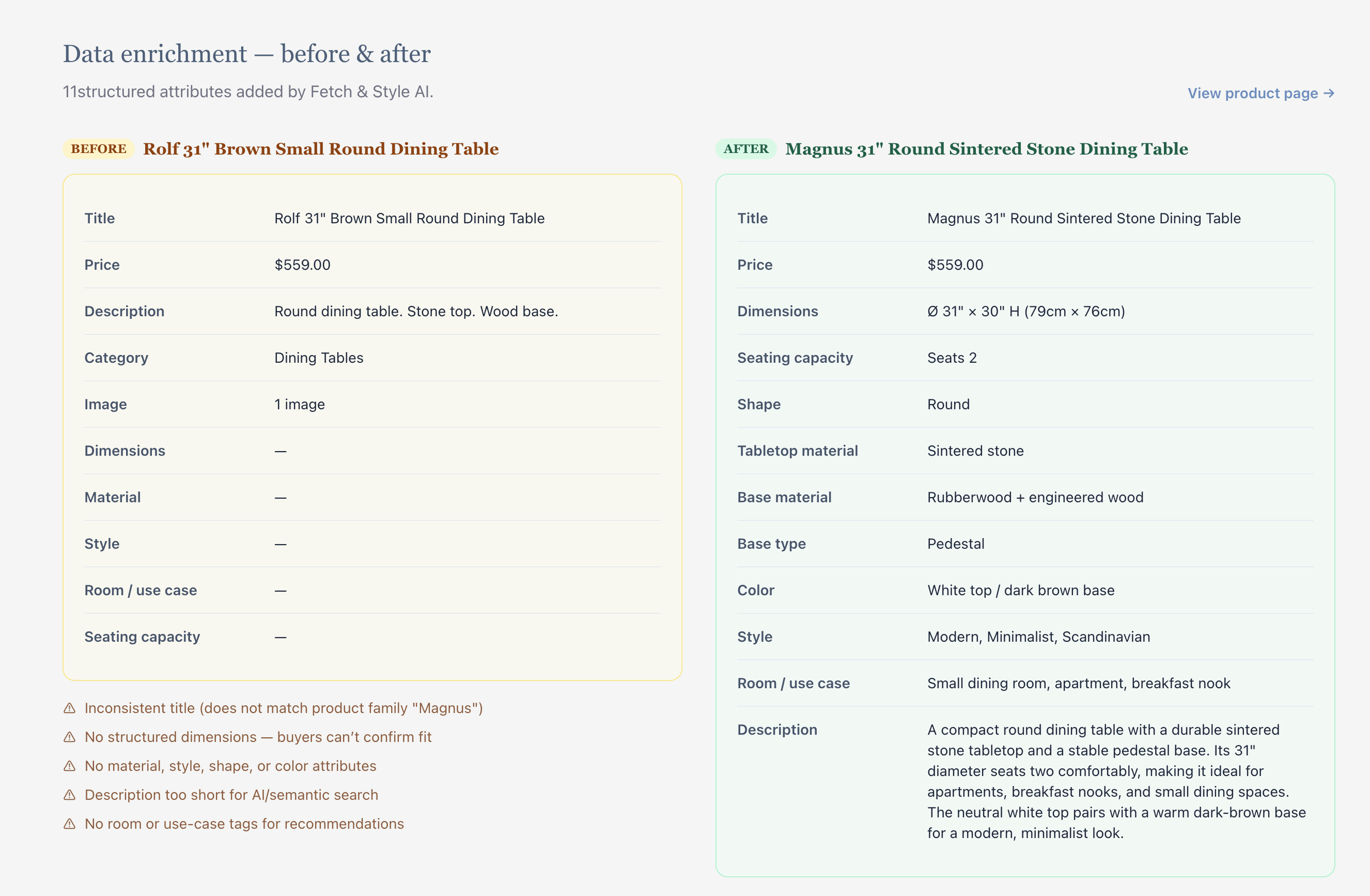
Product data tells us what something is
Traditional product data is largely factual.
A furniture record might contain:
Product name
SKU
Category
Price
Dimensions
Material
Color
Manufacturer
Images
Description
All of this information remains essential.
But it does not necessarily tell an AI system how the product relates to a customer's room, preferences, project, or other products.
Consider a simple accent chair.
The catalog may tell us that it is 31 inches wide, upholstered in cream fabric, and constructed with an oak frame.
Product intelligence goes further.
It can help describe the chair as appropriate for a warm modern living room, compatible with natural woods and neutral textiles, suitable for a particular amount of available floor space, and complementary to other products within a coordinated design.
That additional context changes what AI can do with the product.
AI shopping is moving beyond keywords
Traditional ecommerce search is built heavily around matching queries to products.
AI-powered shopping introduces something different: intent.
A customer may not know the product name, category, material, or terminology needed to search for what they want.
They simply know the outcome they are trying to achieve.
They might ask:
"How can I make this bedroom feel warmer?"
"What size rug should I use with this sectional?"
"Find a dining table that fits six people without overwhelming this room."
"Show me lighting that works with the furniture I already own."
These are not traditional product searches.
They are design and purchasing problems.
To respond effectively, AI needs to understand products through multiple dimensions, including style, scale, relationships, compatibility, context, and customer intent.
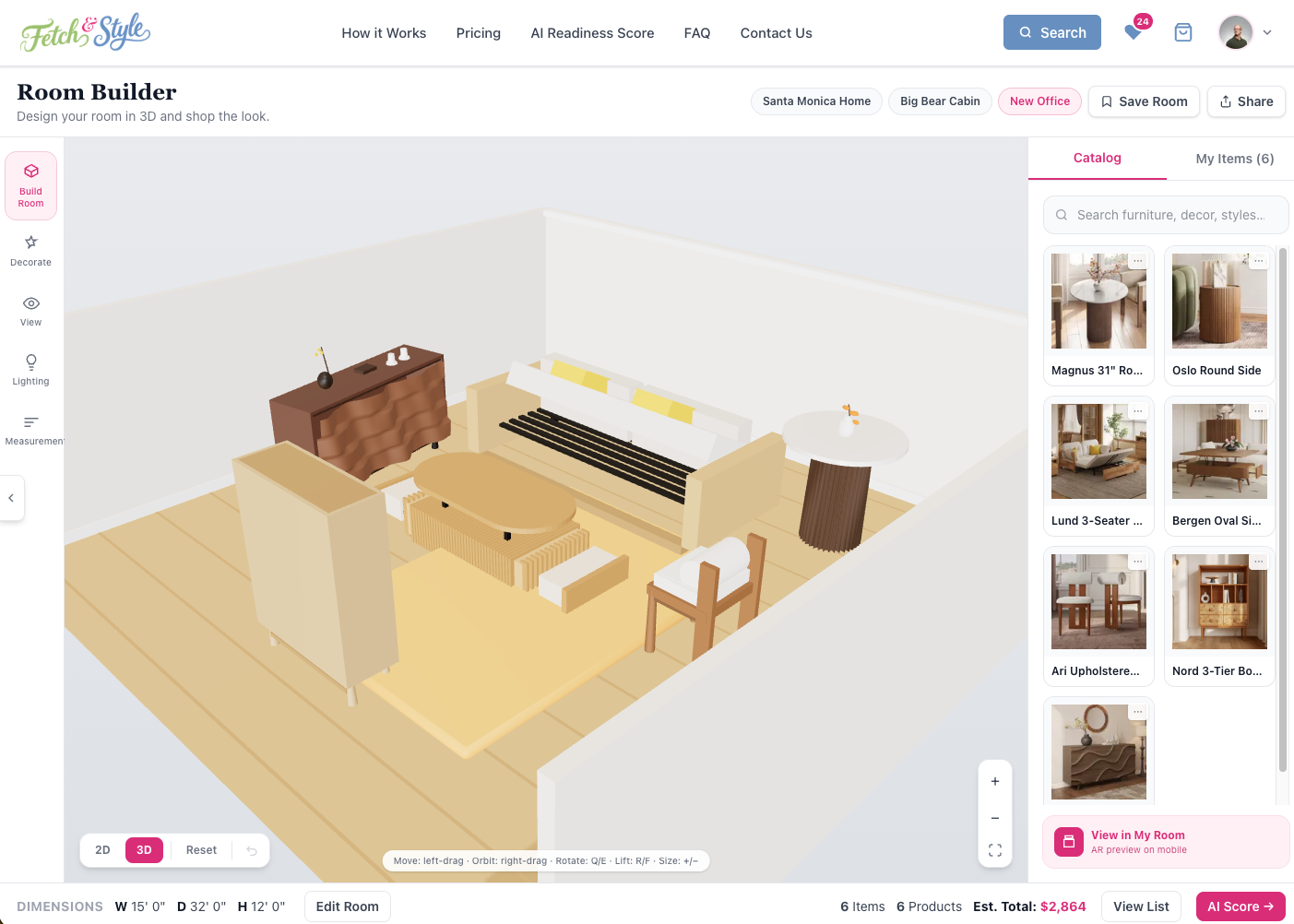
The room adds another intelligence layer
Home furnishings present a unique challenge.
A product does not exist in isolation.
A sofa exists within a room. A rug sits beneath furniture. Artwork relates to a wall. A chandelier relates to ceiling height, table dimensions, and surrounding finishes.
That means the customer's physical environment can become part of the commerce data model.
Instead of asking only:
What product is the customer searching for?
AI-powered spatial commerce can begin asking:
What product makes sense in this particular space?
A customer's room can provide context around dimensions, existing furnishings, colors, layout, style, and available space.
Combine that spatial understanding with intelligent product data and the shopping experience changes dramatically.
The catalog becomes responsive to the room.
Is your product catalog ready for AI commerce?
See how well AI shopping engines can discover, understand, and recommend your products.
Product relationships become increasingly valuable
One of the most important opportunities in product intelligence is understanding how products relate to one another.
Traditional merchandising may manually create collections such as "Modern Living Room" or "Coastal Bedroom."
AI can potentially make these relationships far more dynamic.
A system can understand that a particular sofa may coordinate with certain rugs, tables, lighting, artwork, and accessories based on attributes and context.
This creates the foundation for more intelligent cross-selling.
Instead of simply displaying:
"Customers also bought..."
commerce can move toward:
"These products work together in your room."
That is a fundamentally different recommendation.
It moves ecommerce from transaction history toward contextual design intelligence.
Existing catalogs do not have to be rebuilt
The transition toward product intelligence does not necessarily mean retailers and manufacturers need to replace their existing commerce infrastructure.
Their current product data remains the foundation.
Existing information such as product photography, descriptions, specifications, dimensions, materials, colors, categories, and inventory can be enhanced with additional semantic and contextual intelligence.
AI can help identify and generate attributes that may not exist explicitly in the original product record.
For home furnishings, that could include:
Design style
Visual characteristics
Color relationships
Room suitability
Spatial considerations
Complementary products
Design compatibility
Natural-language concepts
Customer intent signals
The objective is not simply to create more metadata.
The objective is to make the catalog more understandable and useful to intelligent systems.
Product intelligence can extend beyond the retailer's website
This shift becomes even more important as product discovery expands beyond traditional ecommerce websites.
Consumers are increasingly interacting with AI assistants, conversational search experiences, recommendation systems, visual discovery tools, and emerging shopping agents.
In this environment, a retailer's website may no longer be the first place a customer encounters a product.
AI may become an intermediary between the consumer and the catalog.
That creates a new question for every retailer and manufacturer:
Can intelligent systems understand enough about our products to recommend them in the right context?
Being crawlable is one part of the equation.
Being understandable is another.
From search to solutions
Perhaps the biggest change is philosophical.
Traditional ecommerce asks:
"What product are you looking for?"
AI commerce can ask:
"What are you trying to accomplish?"
For home furnishings, that could mean moving from:
"Search sofas"
to:
"Help me redesign this living room."
The AI can then interpret the room, understand the customer's preferences and constraints, identify appropriate products, recommend combinations, visualize possibilities, and ultimately create a shoppable solution.
The individual SKU still matters.
But the SKU becomes part of a larger intelligence layer connecting product, person, place, and intent.
The opportunity for home retailers and manufacturers
The next generation of digital commerce may not be defined by who has the largest catalog.
It may be defined by whose catalog can be understood and acted upon most effectively by AI.
That makes product intelligence an increasingly important infrastructure layer.
Retailers and manufacturers can begin by asking:
Can AI clearly identify our products?
Are important product attributes structured and accessible?
Can products be understood beyond basic categories and keywords?
Can our products be matched to customer intent?
Can products be related intelligently to other products?
Can recommendations account for the customer's actual space?
Can AI move a customer from inspiration to a relevant set of purchasable products?
These questions move the conversation beyond product data management.
They move it toward product intelligence.
The catalog is becoming intelligent
The product catalog is not disappearing.
It is evolving.
The next generation of catalogs will not simply store information about products. They will help intelligent systems understand how those products relate to people, spaces, styles, projects, and one another.
For home furnishings, that creates an especially powerful opportunity.
The room can become the context.
AI can become the guide.
And product intelligence can become the connective layer that turns customer intent into commerce.
About Fetch & Style
Fetch & Style is building an AI-powered spatial commerce platform for the home furnishings industry, connecting product intelligence, room understanding, visualization, personalized recommendations, and commerce.
Our goal is simple: help consumers move from "I want to change my room" to "These are the products that will work in it."
Explore Fetch & Style:
https://fetchandstyle.com/demo
