
Beyond Search
How AI Is Becoming the New Commerce Interface
For more than two decades, digital commerce has been built around a familiar behavior: search, scroll, compare, click.
That behavior is beginning to change.
Consumers are increasingly starting shopping journeys by simply telling an AI what they want.
“Find me a sofa that works with my living room.”
“I love this chair, but find me something similar for half the price.”
“I need a dining table for six that will actually fit my space.”
These aren't conventional search queries. They are expressions of intent.
And that distinction could fundamentally reshape commerce.
From Search Engines to Decision Engines
Traditional ecommerce puts most of the work on the consumer.
Search for a product. Open ten tabs. Compare dimensions. Read reviews. Check inventory. Decide whether the color works. Measure the room. Second-guess the decision. Repeat.
AI has the potential to collapse much of that journey into a conversation.
Early commerce data suggests that shift is already underway.
Shopify reported that AI-referred sessions to its storefronts grew 197% year over year, while organic search also continued to grow. More importantly, shoppers arriving from AI aren't behaving like traditional search visitors. When AI-referred shoppers reached product pages, they converted about 80% better than organic-search shoppers, with the advantage rising to roughly 2x in research-intensive categories.
Shopify calls this phenomenon buyer journey compression.
The AI has already helped the shopper research, compare and narrow the field before the consumer reaches the merchant.
The product page isn't necessarily the beginning of consideration anymore.
It may be the end of it.
The More Complicated the Purchase, the More Valuable AI Becomes
This shift becomes particularly interesting in high-consideration categories.
Buying a commodity is relatively simple. Buying something that must satisfy several simultaneous requirements is not.
Furniture and home décor may be among the clearest examples.
A sofa isn't simply a sofa.
It has dimensions. Aesthetic compatibility. Material. Color. construction quality. Delivery constraints. Price. Availability. And, most importantly, it has to work within a physical environment filled with things the consumer already owns.
The shopper isn't really asking:
“Which sofa should I buy?”
They're asking:
“Which sofa should I buy for this room?”
That is a fundamentally different computational problem.
And it's why the next generation of commerce will require more than increasingly intelligent search.
It will require context.
Context Is Becoming the New Commerce Interface
Imagine an AI that doesn't begin every shopping conversation from zero.
It already understands the dimensions of your living room.
It knows the sofa you own, the rug underneath it and the coffee table across from it.
It understands the styles and colors you've repeatedly gravitated toward.
It knows your preferred price range.
And it can connect that information to live product catalogs across hundreds of brands.
Now the consumer can say:
“Find me a new chair for this corner.”
Behind that simple request is an extraordinarily sophisticated query.
The system can determine how much physical space is available. It can understand the existing room aesthetically. It can search across brands. It can eliminate products that don't fit. It can compare price and availability. And it can present a small number of highly relevant options rather than hundreds of search results.
The interface becomes less about navigating a catalog and more about communicating an outcome.
That's the transition from search engine to shopping agent.
The Product Catalog Is Becoming Machine-Readable Infrastructure
This change also has enormous implications for retailers.
In an AI-mediated shopping environment, having the right product is no longer enough.
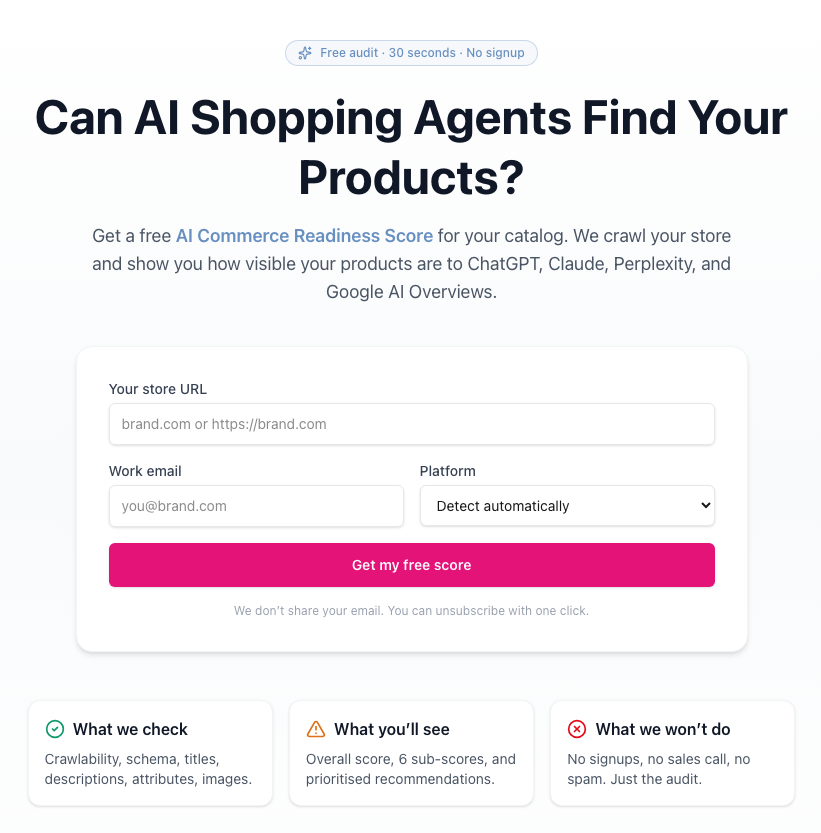
AI has to be able to understand it.
Dimensions, materials, colors, styles, compatibility, inventory, price, images, reviews, delivery information and dozens of other attributes become part of the machine-readable language of commerce.
Shopify's early data provides an important signal here.
When AI systems drew on structured Shopify Catalog product data, the shoppers they referred converted at approximately twice the rate of shoppers arriving from AI sessions relying on scraped or third-party product feeds.
That suggests something important:
Structured product data isn't just ecommerce infrastructure anymore. It is AI infrastructure.
Retailers spent the last generation optimizing websites for search engines.
The next generation will require them to optimize product intelligence for agents.
From Personalization to Persistent Intelligence
For years, ecommerce personalization has largely meant recommendations based on behavioral signals.
“You looked at this, so you might like that.”
Agentic commerce has the potential to go much further.
An AI shopping agent can maintain context over time.
It can understand what you own, what you like, what fits, what you've considered buying and what you're waiting for.
Instead of merely responding to a search, it can continue working after the shopper leaves.
“Tell me if this table drops below $1,500.”
“Find something similar if this chair comes back in stock too late.”
“Let me know when you find a rug that works better with this room.”
“Refresh this space for the holidays without replacing the furniture.”
Google Cloud's 2026 AI agent research points toward precisely this broader shift: AI moving from answering questions to understanding goals, developing plans and taking actions across systems with human guidance and oversight.
In commerce, that changes the relationship between shopper and retailer.
Shopping becomes continuous rather than episodic.
The Rise of Spatial Commerce
At Fetch & Style, we believe the home represents an especially powerful environment for this transformation.
We're building around a simple idea:
AI shouldn't recommend products without understanding the space they're going into.
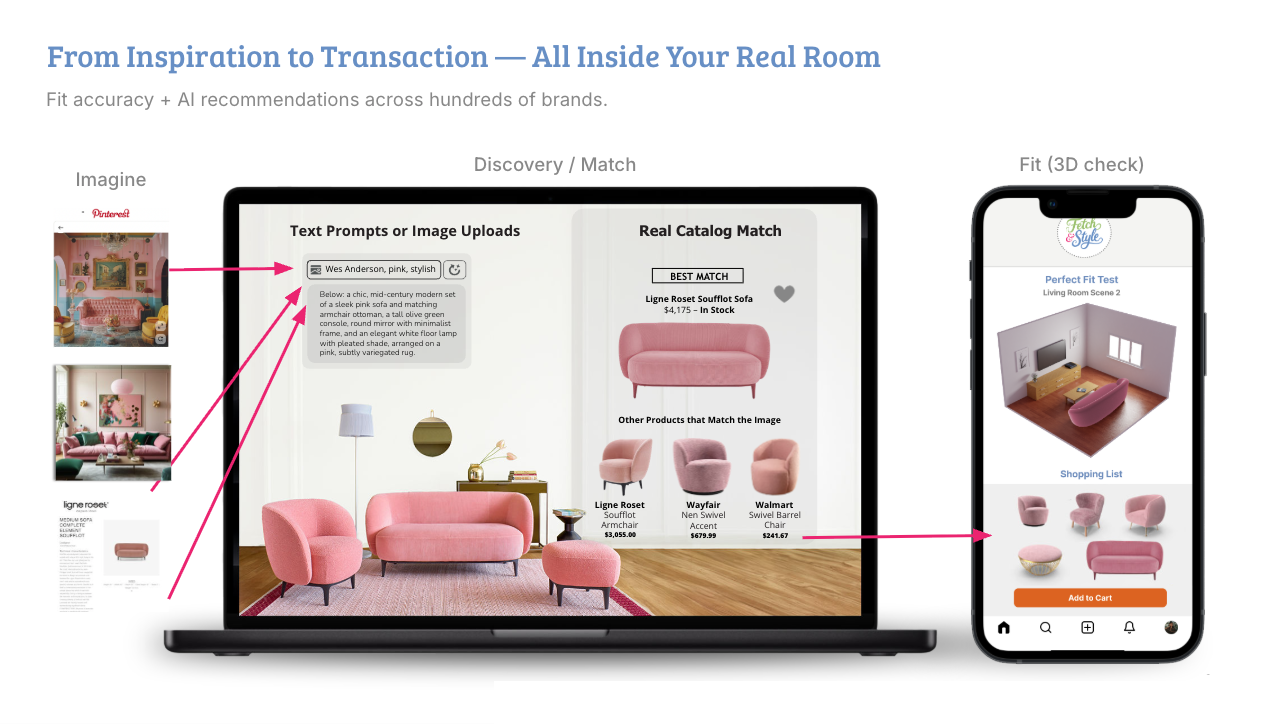
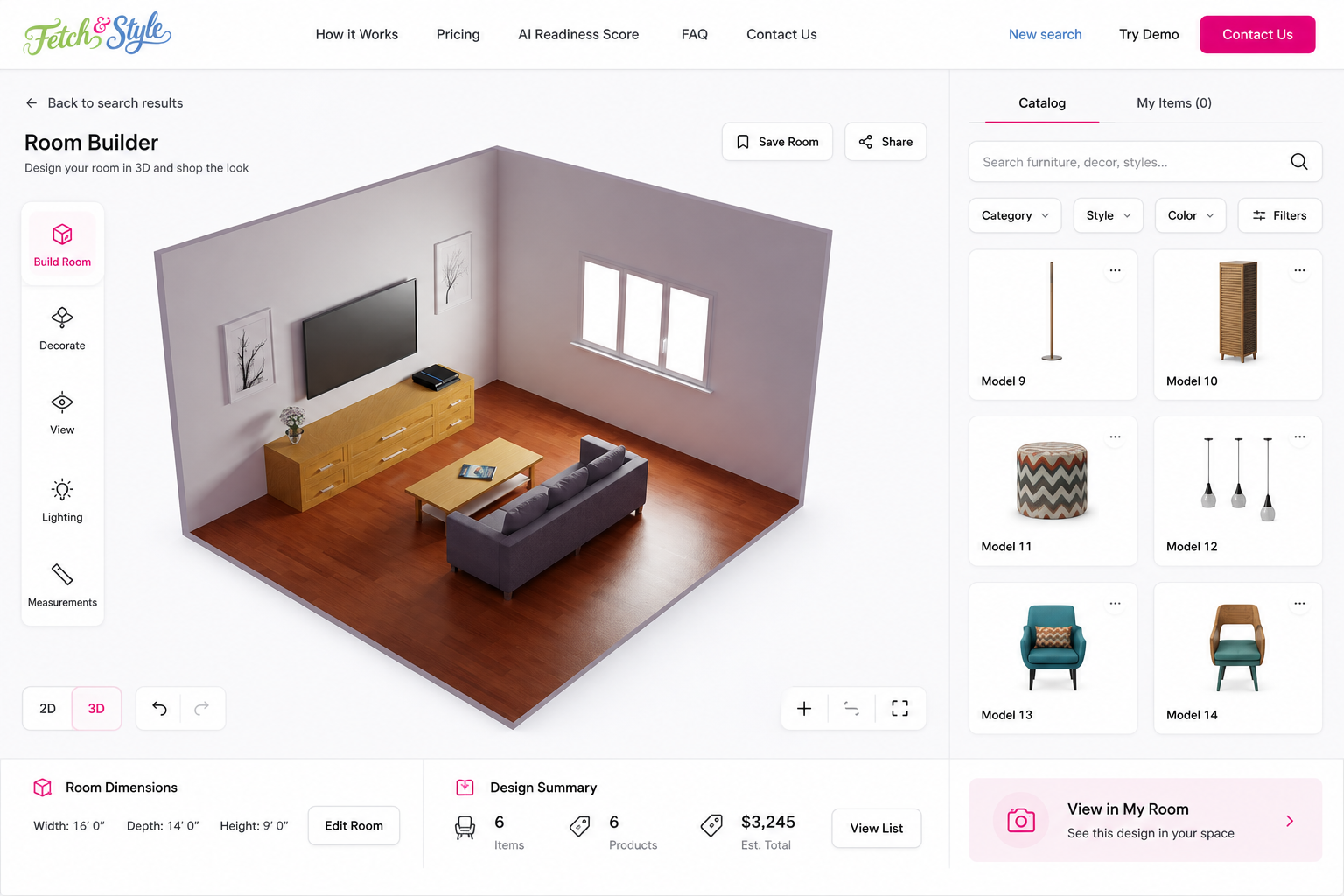
A digital twin of the home can give an AI agent something general-purpose shopping assistants don't inherently possess: spatial context.
Combine that spatial intelligence with aesthetic preferences, product information and multi-brand inventory, and a new kind of commerce experience becomes possible.
A consumer could move from inspiration to visualization to product matching to fit validation to purchase without leaving the same intelligent environment.
Instead of searching through individual retailer catalogs, the shopper expresses the desired outcome.
The system does the legwork.
That is the promise of spatial commerce.
The Storefront Is No Longer the Only Front Door
There is a larger implication for the commerce industry.
For decades, retailers competed to become the destination.
Consumers went to the store.
Then consumers went to the website.
Then they went to marketplaces and social platforms.
Now another intermediary is emerging: the AI agent.
The winning merchant may increasingly be the one whose products can be discovered, understood and confidently recommended wherever the consumer's conversation begins.
That makes interoperability increasingly important.
The future of commerce is unlikely to consist of hundreds of isolated AI assistants recommending only products from their own catalogs.
Consumers will expect agents to search broadly on their behalf.
They won't ask:
“What is the best sofa sold by Brand X?”
They'll ask:
“What is the best sofa for me?”
That shift favors an open, multi-brand commerce ecosystem.
Commerce Is Moving From Browsing to Orchestration
We are still early.
Organic search remains enormous. Ecommerce sites aren't disappearing. Consumers will continue browsing, exploring and discovering products visually.
But a new layer is forming above those experiences.
AI is beginning to orchestrate the journey.
Search becomes conversation.
Product catalogs become machine-readable knowledge.
Personalization becomes persistent context.
Recommendations become decisions.
And eventually, decisions become actions.
The most important question for retailers may therefore no longer be:
“How do we get consumers to search our catalog?”
It may become:
“How do we make sure intelligent agents understand when our products are right for their customers?”
For home commerce, there is one additional question:
What happens when the agent understands the customer—and the room?
That's where spatial commerce begins.
And it may represent one of the biggest changes to how we shop for our homes since ecommerce itself.
