
How to Make Your Product Pages Visible for AI Agents
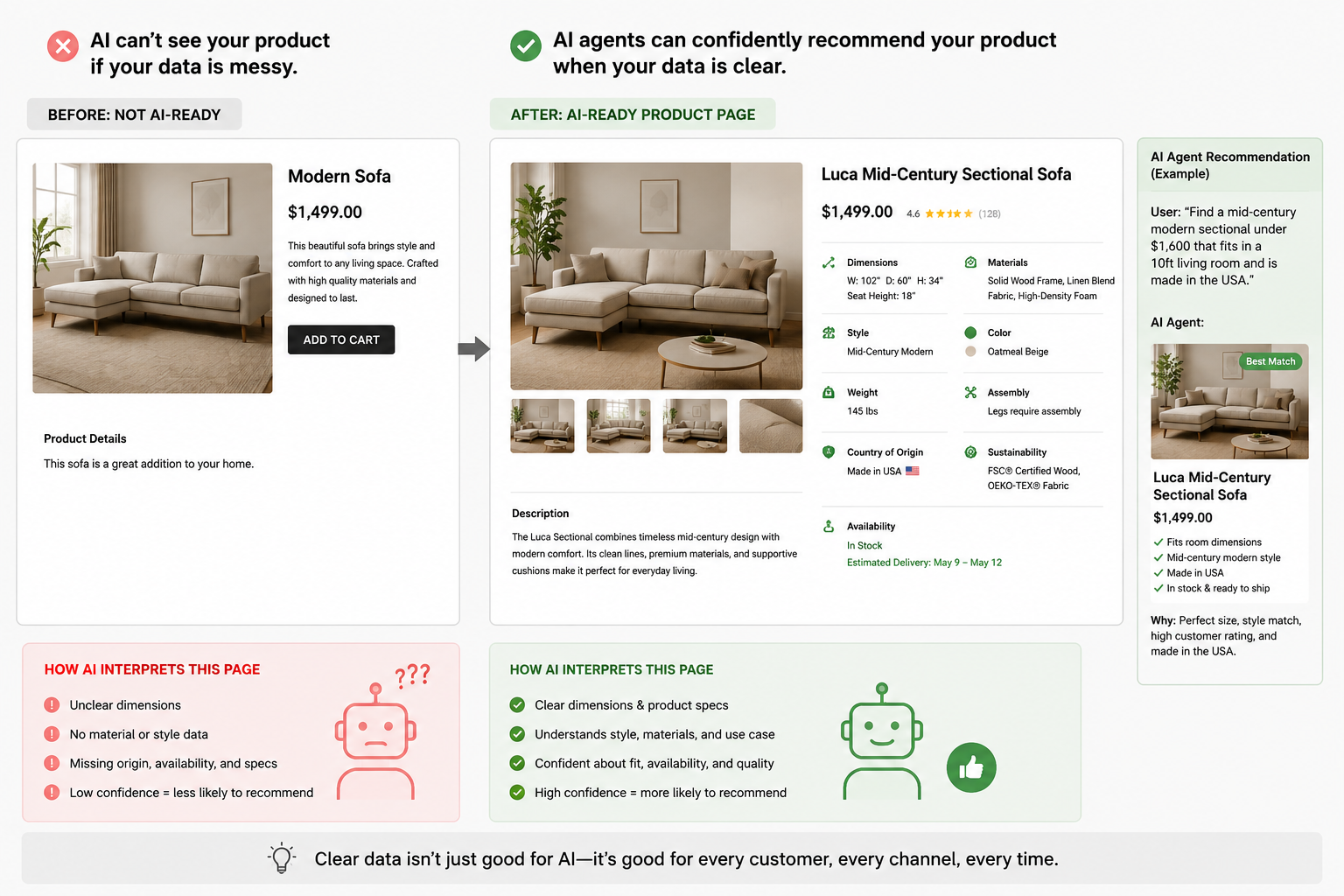
How AI Shopping Agents Discover, Understand, and Recommend Products
Artificial intelligence is transforming commerce.
For two decades, brands optimized product pages for search engines. Today, a new layer of discovery is emerging: AI shopping agents.
Consumers are increasingly asking ChatGPT, Google AI Overviews, Perplexity, Claude, and other AI assistants to find products, compare alternatives, evaluate compatibility, and make recommendations on their behalf.
This shift marks the beginning of a new distribution channel.
The question is no longer:
“How do I rank on Google?”
It is becoming:
“How do I make sure AI shopping agents can discover, understand, and recommend my products?”
As AI-driven commerce grows, product catalogs are evolving from marketing assets into machine-readable knowledge systems. The brands that provide structured, contextual, and AI-ready product data will gain a significant advantage in visibility and recommendation frequency.
The Rise of Agentic Commerce
AI agents don't browse websites the same way humans do.
Traditional shoppers might click through multiple pages, compare specifications, read reviews, and check dimensions before making a purchase.
AI agents compress that process. They scan structured information, understand context, compare thousands of products instantly, and return recommendations in seconds.
As this behavior grows, merchants that provide clear, machine-readable product data will have a significant advantage over those that rely on beautiful imagery and marketing copy alone.
The future of commerce belongs to products that machines can understand as easily as humans.
Why Most Product Pages Are Invisible to AI
Many e-commerce sites still treat product pages like digital brochures.
They contain:
Marketing-heavy descriptions
Incomplete specifications
Missing dimensions
Unstructured product details
Poor metadata
Inconsistent category information
Humans can often work around these gaps.
AI systems cannot.
When an AI agent receives a query such as:
"Find a mid-century modern sofa under $2,500 that fits in a 10-foot living room and is made in the USA."
The AI needs structured facts, not marketing slogans.
If your product page lacks dimensions, style classification, materials, origin information, inventory status, or pricing data, your product may never appear in the recommendation set.
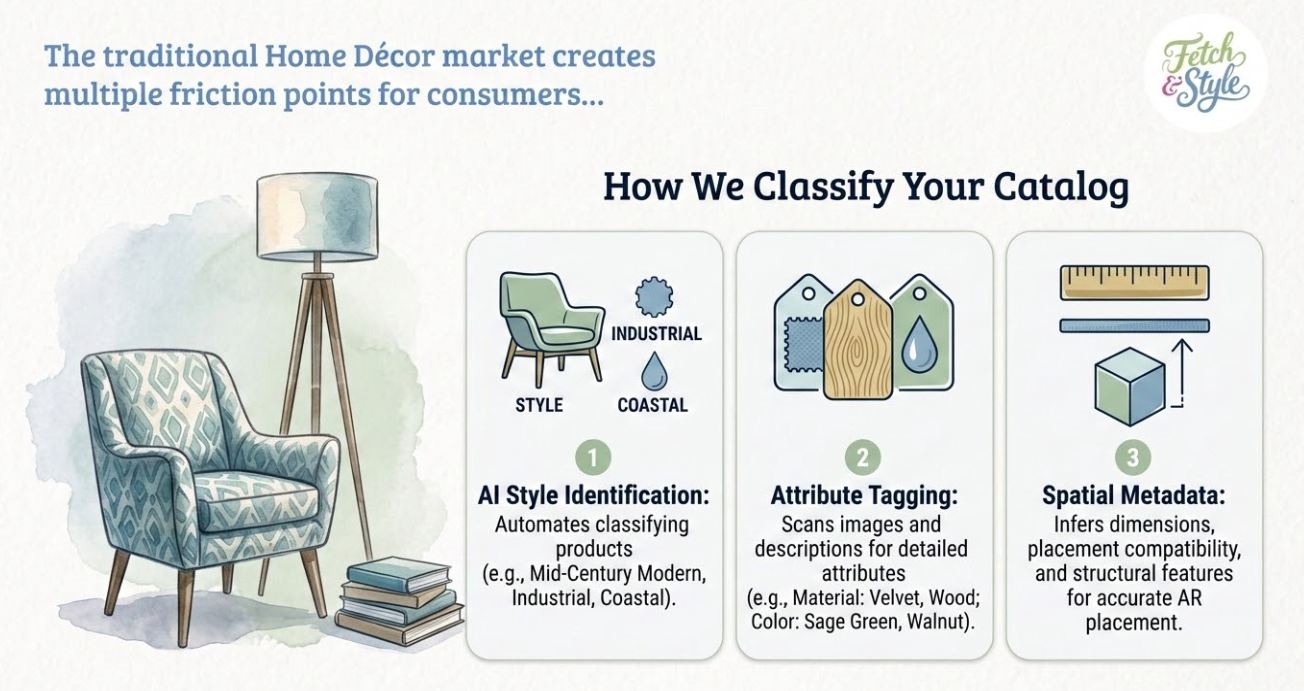
The New SEO: Structured Product Intelligence
To become AI-discoverable, merchants need to think beyond traditional SEO.
Instead of optimizing only for keywords, optimize for understanding.
Every product should contain:
Accurate Dimensions
Include:
Height
Width
Depth
Weight
Seat height (for furniture)
Clearance requirements
AI agents increasingly use dimensional data to determine fit and compatibility.
Rich Attribute Data
Add structured fields for:
Materials
Colors
Finish types
Style categories
Sustainability certifications
Country of origin
Assembly requirements
These attributes allow AI systems to match products against highly specific consumer requests.
Inventory and Availability
AI shopping assistants prefer products they can confidently recommend.
Provide:
Real-time inventory status
Estimated delivery dates
Backorder information
Store availability
Outdated inventory reduces trust and recommendation frequency.
High-Quality Product Images
Visual AI models increasingly analyze imagery directly.
Include:
Multiple angles
Lifestyle photography
Close-up material shots
Room-context imagery
The more visual context available, the better AI can understand style, scale, and use cases.
Think Like an AI Query
Many merchants optimize for searches such as:
"Blue sofa"
"Dining table"
Consumers using AI agents ask much more nuanced questions:
"What sofa would look good with walnut floors and white walls?"
"Show me alternatives to a Restoration Hardware sectional under $2,000."
"Find sustainable dining chairs that fit a small apartment."
To appear in these conversations, product data must include semantic context.
A chair should not simply be tagged "chair."
It should also be described as:
Scandinavian
Minimalist
Apartment-friendly
Sustainable
Oak wood
Light finish
Small-space compatible
The richer the context, the more opportunities AI has to match your product.

Traditional Search
User Query
↓
Keywords
↓
Results
AI Shopping Agent
User Intent
↓
Visual Context
↓
Style Matching
↓
Product Intelligence
↓
Recommendation
Beyond Structured Data: The Product Intelligence Layer
Structured product data is the foundation of AI discoverability, but it is no longer enough.
AI shopping agents increasingly need context, not just attributes.
A sofa is not simply:
Width: 92 inches
Color: Blue
Material: Linen
It is also:
Coastal-modern
Family-friendly
Apartment-compatible
Suitable for open-concept living spaces
Visually compatible with light oak flooring and neutral interiors
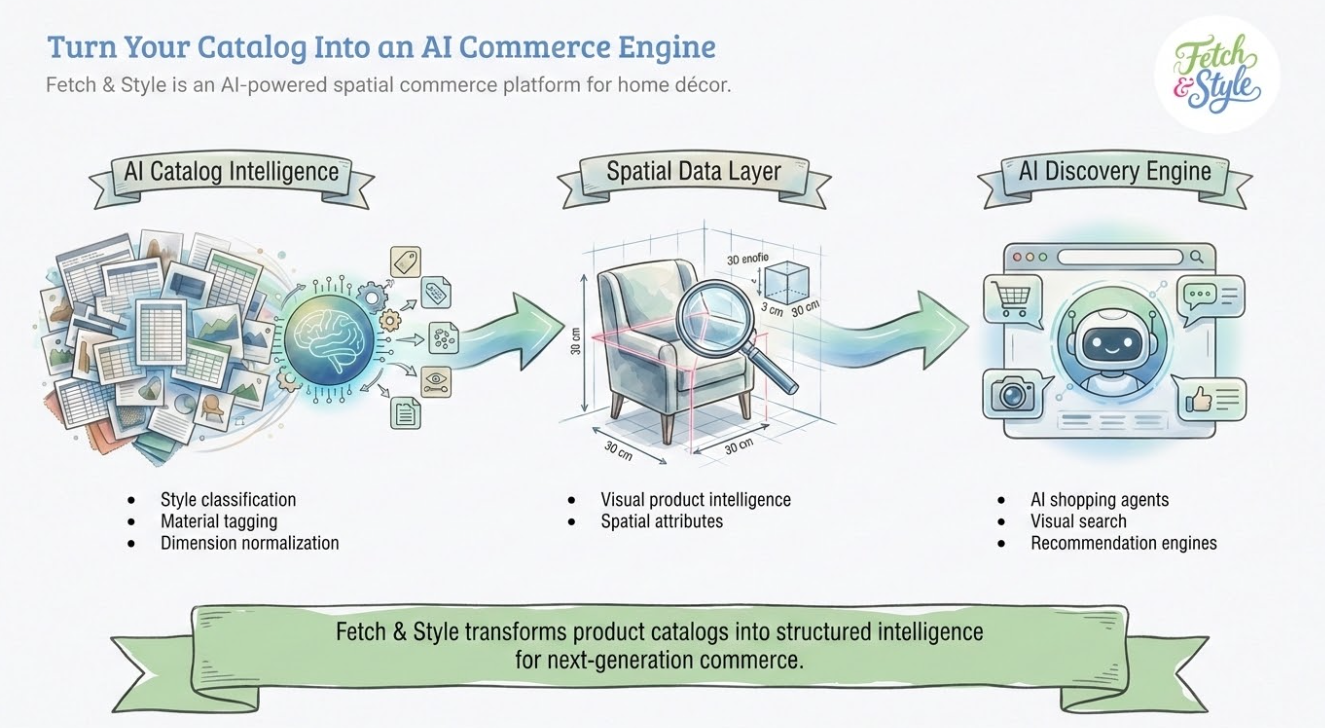
This additional context creates what Fetch & Style calls Product Intelligence: a richer representation of products that combines specifications, visual characteristics, style attributes, spatial compatibility, and shopper intent.
As AI commerce evolves, recommendation systems will increasingly favor catalogs that provide both structured product data and contextual product intelligence.
Why Spatial Commerce Changes Everything
One of the biggest limitations of traditional e-commerce is that products exist outside the context of a consumer's actual space.
Consumers don't buy furniture.
They buy confidence that furniture will fit, match, and improve their home.
This is where spatial commerce is creating a new category of AI-powered shopping.
Platforms such as Fetch & Style combine room scanning, AI design intelligence, and product data to understand not only the product, but also the environment where it will be used. The platform's vision is to create a digital twin of the consumer's home, allowing AI to recommend products based on dimensions, style preferences, room context, and real-world compatibility rather than simple keyword matching.
In this model, product data becomes dramatically more valuable.
AI can answer questions such as:
Will this sofa fit?
Does this rug match the room?
What alternatives look similar but cost less?
What products complete the design?
The brands that provide complete, machine-readable product information will become the preferred inventory source for these systems.
Build an AI-Ready Product Catalog
To prepare for the next generation of commerce, merchants should audit their catalogs against five key areas:
1. Complete Product Specifications
Every product should have comprehensive dimensional and technical data.
2. Consistent Taxonomy
Use standardized categories, styles, materials, and attributes.
3. Structured Metadata
Ensure information can be consumed by APIs, feeds, and AI systems.
4. Visual Intelligence
Provide multiple high-quality images and, where possible, 3D assets.
5. Real-Time Data Feeds
Keep pricing, inventory, and availability updated continuously.
The Competitive Advantage
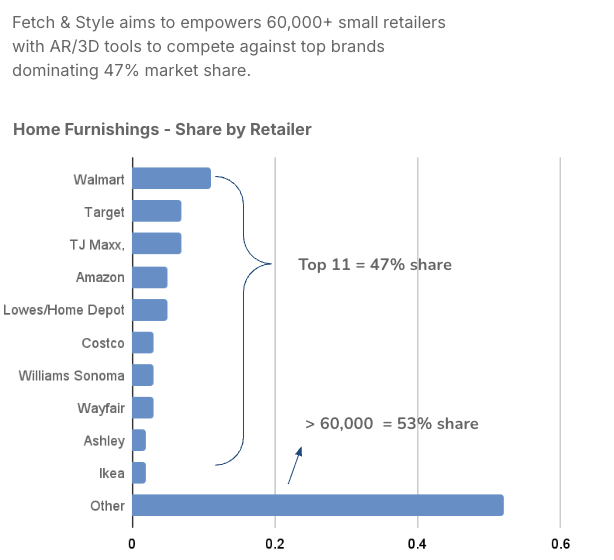
The Next Distribution Channel
For years, search engines determined which products consumers discovered.
Increasingly, AI shopping agents will influence which products consumers compare, shortlist, and purchase.
This shift creates a new competitive landscape.
The winners will not necessarily be the brands with the largest catalogs.
They will be the brands whose catalogs are easiest for AI systems to understand, evaluate, and recommend.
In the era of AI commerce, every product page becomes part of a machine-readable knowledge base.
The future customer may never visit your website first.
Their AI shopping agent will.
The question is whether your products will be visible when it arrives.
See how your catalog scores.
Run Your Free Audit: AI Commerce Readiness Score
Book a Strategy Call: Fetch & Style
