
The Future of Home Décor Commerce Isn't More AI.
For the past decade, home furnishings retailers have invested heavily in ecommerce. Better photography. Better search. Better recommendations. Faster fulfillment.
Yet one problem continues to cost the industry billions every year.
Customers still cannot confidently answer one simple question before they buy.
"Will this actually work in my home?"
That uncertainty drives hesitation, abandoned carts, and some of the highest return rates in retail.
As AI transforms nearly every customer interaction, the next competitive advantage will not come from generating more content. It will come from giving AI spatial understanding.
The next evolution of ecommerce is Spatial Commerce.
The Missing Layer in Digital Retail
Today's ecommerce experience is sophisticated, but it remains disconnected from the customer's reality.
Retailers know what products customers browse, what styles they prefer, their purchase history, price sensitivity, and demographics.
What they do not know is often more valuable.
They do not know the dimensions of the customer's living room. They do not know whether a sectional fits through the doorway, if a dining table overwhelms the space, or whether two products actually complement each other. They also have little understanding of what already exists inside the customer's home.
Without context, every recommendation is incomplete.
Imagine recommending luggage without knowing whether it fits in someone's vehicle.
That is essentially how furniture is sold today.
The Shift from Product-Centric to Space-Centric Commerce
For decades, digital merchandising has revolved around individual products.
Search.
Browse.
Compare.
Purchase.
But consumers are not shopping for another SKU. They are trying to create a better room.
That is a fundamentally different challenge.
The room is becoming the primary interface for commerce.
Instead of asking customers to imagine products inside their homes, retailers can begin with the home itself.
Once the room becomes a digital asset, every recommendation becomes smarter. Every product gains context. Every merchandising decision becomes more personalized.
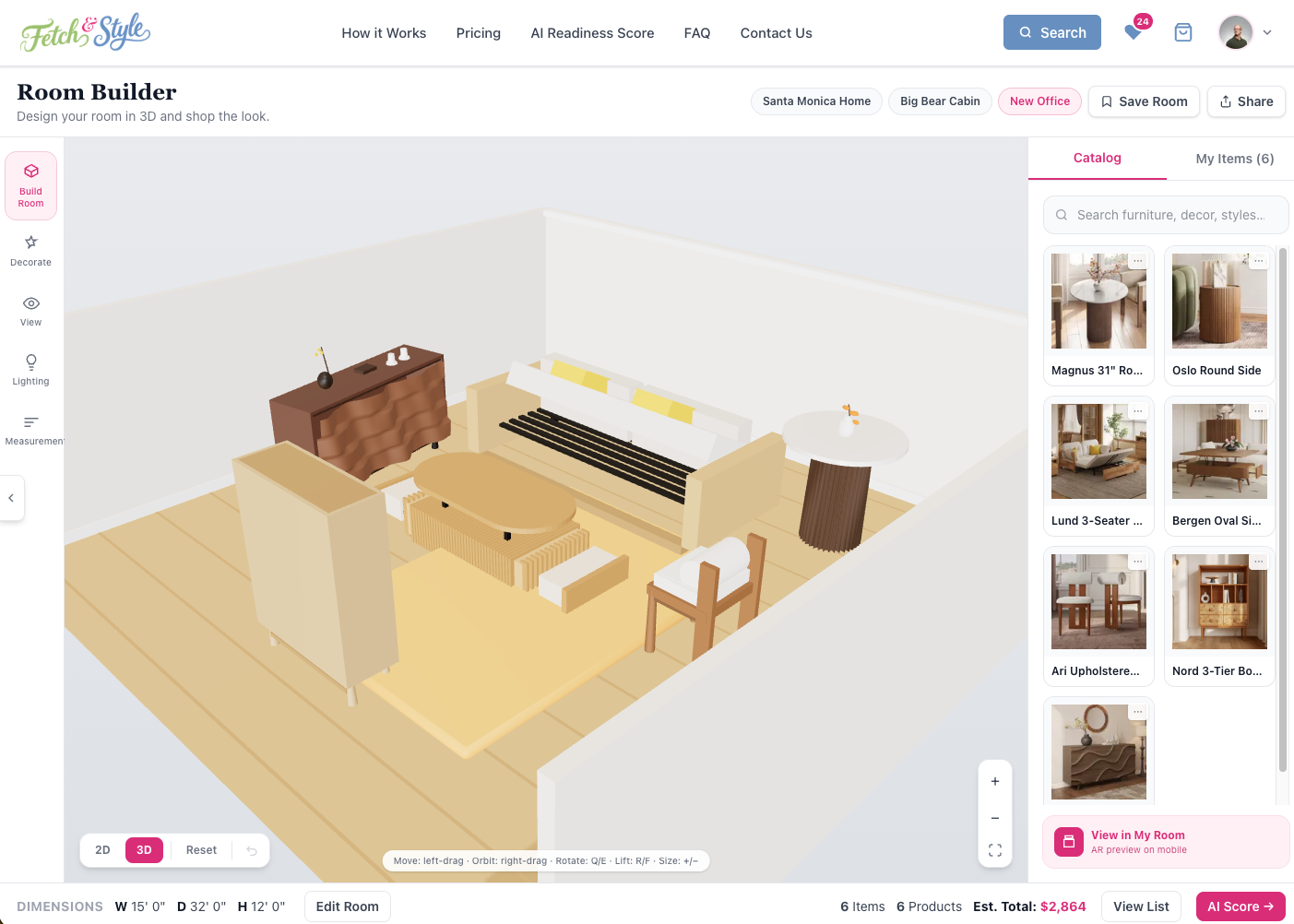
Solving the 3D Challenge Without Waiting for Perfect 3D
One misconception has slowed innovation across the industry.
Many believe every product must have a detailed 3D model before meaningful room visualization is possible.
That simply is not true.
Most retailers already possess the information needed to create valuable spatial shopping experiences.
Product photography
Accurate dimensions
Product metadata
Pricing and inventory
Combined with LiDAR-based room scanning, these existing assets allow customers to answer the question that matters most.
Will this fit?
Rather than waiting years for millions of handcrafted 3D assets, retailers can create dimensionally accurate room visualizations using the catalog they already own.
As premium GLB or USDZ models become available, they enhance the experience. They are not a prerequisite for delivering value.
This approach allows spatial commerce to scale across entire catalogs instead of a limited collection of hero products.
Why This Matters to Merchandising Leaders
Spatial commerce is far more than another visualization feature.
It changes how merchandising works.
Instead of presenting endless products, retailers can present complete room solutions.
Instead of recommending similar products, AI can recommend products that fit the customer's room, complement existing furnishings, align with their design preferences, and meet their budget.
This creates an entirely new layer of merchandising intelligence.
Retailers can understand which products are most frequently placed together, which layouts generate the highest conversion, which room styles increase average order value, and which product dimensions create the most shopping friction.
These insights have never existed at scale.
A New First-Party Data Asset
Every room scan creates a living digital twin.
Over time, that digital twin becomes one of the most valuable first-party data assets a retailer can own.
It evolves as customers move, renovate, purchase new furniture, or update their style.
Commerce becomes continuous instead of transactional.
Rather than waiting for customers to begin another shopping journey, AI can proactively recommend seasonal updates, complementary products, replacements, and price alerts based on the customer's actual living environment.
The relationship shifts from occasional shopping to ongoing design.
What This Means for Wholesale Brands
Manufacturers face a different challenge.
Most compete primarily through wholesale distribution, making differentiation difficult beyond product quality and price.
Spatial commerce creates a new competitive advantage.
Brands that provide richer digital product information, including dimensions, imagery, materials, and eventually 3D assets, become easier for retailers to merchandise, visualize, and sell.
Digital product quality becomes as important as physical product quality.
As retailers invest in immersive shopping experiences, manufacturers with stronger digital assets will gain greater visibility and stronger conversion.
The Competitive Landscape Is Changing
The industry has already embraced AI-generated recommendations.
The next competitive frontier is contextual intelligence.
The winners will not simply know what customers like.
They will understand where customers live, how they use their space, and how every product fits within that environment.
This is not just augmented reality.
It is not another room planner.
It is the emergence of a new commerce layer that connects product data, spatial understanding, merchandising intelligence, and AI into a single shopping experience.
Looking Ahead
Home décor has always been one of the most emotional and most difficult categories to purchase online.
The retailers and manufacturers that remove uncertainty will earn trust.
The companies that combine AI with spatial understanding will create experiences that competitors cannot easily replicate.
The future of home furnishings will not be built around larger catalogs.
It will be built around a richer context.
And that context begins with understanding the room.
About Fetch & Style
Fetch & Style is building the home décor industry's first end-to-end spatial commerce platform, combining LiDAR-based room scanning, AI-powered design assistance, multi-brand product discovery, and intelligent room visualization into a unified commerce experience. By transforming real rooms into personalized shopping environments, Fetch & Style helps retailers, wholesalers, and brands increase shopper confidence, improve conversion, and reduce costly returns.
